Via Flickr:
Remote Shooter 3.0 is a smart device to control wireless your digital camera from an Android APP, tablet or a PC.
Now on Indiegogo.com crowfonding campaign:
igg.me/at/remshoot30/x/2778971
Spread the word!
thanks!

Quattro passi nel mondo della tecnologia e delle curiosità
Visualizzazione post con etichetta canon. Mostra tutti i post
Visualizzazione post con etichetta canon. Mostra tutti i post
martedì 23 aprile 2013


martedì 16 aprile 2013
Nikon Remote Shutter for Canon
Ok it's a fake, if you are searching for your digital cam a real, wireless and flexible remote shutter, time lapse and more, go to http://igg.me/at/remshoot30
This was my first serious SLR Camera, a CanonFlex RP, when i was 16 years old.

This was my first serious SLR Camera, a CanonFlex RP, when i was 16 years old.
venerdì 29 marzo 2013
Help Remshoot 3.0 become a reality!
The Project Remshoot 3.0
Our project was initially designed to control few digital cameras as Nikon D50, but it can control many other digital cameras (our focus will be on Nikon and Canon DSLR and Coolpix or Powershot compact series) using the PTP standard, everything depends on the specific functions provided by the camera you own.Once connected to the USB port on the camera, with the function of discovery capabilities, Remote Shooter 3.0 knows which commands and properties are available. For limited features as Focus&Release combined with Time Lapse, a stereo jack 2.5 port is available. Just buy a cable suitable for your remote control port specific for your camera.
Our goal is selling an flexible, upgradable and open Camera Control, for appassionate and professional at lower price possible!
Main features:
- Remote Shoot;
- Time Lapse (interval in sec,repeatition);
- Shutter Speed Settings;
- Aperture Settings;
- Iso Settings;
- Bracketing on/off;
- Shake&Shoot (using your android phone accelerometer);
- Sound&Shoot (adjustable level using your android phone mic);
- Read&Shoot (programmable actions by a simple scripting language)
- Thumbnail on app of the last shoot
- USB PTP mode connection for full control (depends on camera)
- Jack port 2.5mm for simple focus and release control
- I/O port expansion for external sensor/actuator (eg light sensor or flash,may need a board interface)
- Wireless firmware Upgrade (many other features on plan)
- Li-Po Battery rechargeable from any phone microusb power supply
With a language of simple and intuitive controls, you can control your camera.
We use Google App Inventor for Android to create the GUI editable by anyone, so it will be easy to implement custom functions so far unthinkable.
If you have no programming skills, you can write a sequence of
commands to a text file, click a button on your smartphone and will be
read and executed by the application.
PTP Command.txt
//Script to activate Time-Lapse ,
100 shots, one every 30 seconds
TIMERIP=100. Set number of shot
TIMEINT=30. Set interval between shot, in seconds
ENTIMER=1. Enable Time Lapse
video
//Script to activate Time-Lapse ,
100 shots, one every 30 seconds
TIMERIP=100. Set number of shot
TIMEINT=30. Set interval between shot, in seconds
ENTIMER=1. Enable Time Lapse
video

Technicality for geeks! :-)
Processor PIC24FJ64GB002 16BIT, USB-OTG 8K Ram,16Mips@32Mhz
Program Memory 64K Flash
Communication Bluetooth serial module class2 certified 30ft/10mt coverage
Power supply 3,7V 750mAh LiPo onboard battery
Size 60 x 60 x 25 mm, 50 grams
Firmware tested so far on:
Nikon D50 (full features, see video)
Nikon Coolpix AW100
Canon Powershot A300
Canon Poweshot S500

Hello guys, we Need €16,500 to make RemShoot 3.0 project become reality!
With your help, we'll raise the €16,500 that we need to:
If you are a fan of Creative Photography and HI-Tech, we toughly recommend the RemShoot 3.0 Limited Edition at €75 each (Italy shipping included; add 15 euro for International shipping).
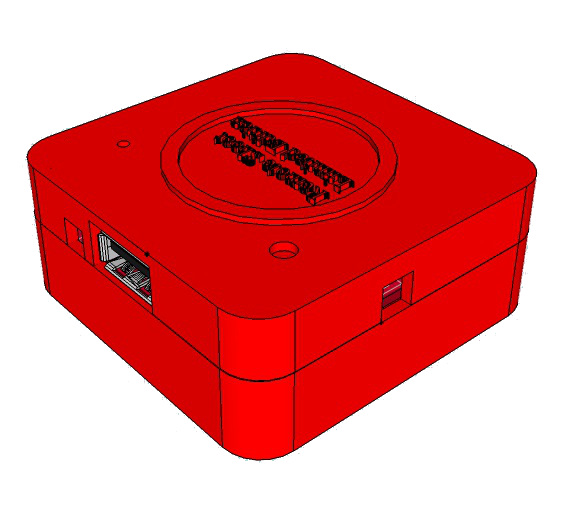
With this Kit, you'll get a finished product in a resin, original enclosure box, in one of 4 color at your choice (Red, Black, Blue or Yellow), the board fully tested and programmed with the latest firmware available. Each RemShoot 3.0 kit contains moreover a rechargeable LiPo battery, with it’s dedicated micro USB port for charging, 1 Bluetooth module to wireless interact with the application on Android devices or a PC running Windows S.O, the app RemShoot for Android, (including source code) , the customized Pc Windows tool to easily upgrading via Bluetooth the board.
Last but not least, we plan to make several upgrades and implement other features to enrich RemShoot 3.0 Project, so it’s wireless firmware upgradable from a PC Windows via Bluetooth. You can free your creativity with RemShoot 3.0
Processor PIC24FJ64GB002 16BIT, USB-OTG 8K Ram,16Mips@32Mhz
Program Memory 64K Flash
Communication Bluetooth serial module class2 certified 30ft/10mt coverage
Power supply 3,7V 750mAh LiPo onboard battery
Size 60 x 60 x 25 mm, 50 grams
Firmware tested so far on:
Nikon D50 (full features, see video)
Nikon Coolpix AW100
Canon Powershot A300
Canon Poweshot S500
What We Need & What You Get
Hello guys, we Need €16,500 to make RemShoot 3.0 project become reality!
With your help, we'll raise the €16,500 that we need to:
•Get the boards CE certified – Regrettably, In
Italy this is an expensive process for the certification lab to give us
the ability to distribute the product.
•Produce the first run of boards – In the past we've been prototyping previous versions through very small but expensive batches of boards.
•Develop and test compatibility over a wide range
of Digital Cameras (as many possible, but at the beginning our primary
goal will be on Nikon and Canon DSLR or Coolpix and PowerShot compact
series)
Today we plan to develop mainly on:
Canon EOS 30D,EOS 40D,EOS 60D,EOS 400D,EOS 450D,EOS 500D,EOS 550D, PowerShot SX220 HS
Nikon D50,D60,D70,D90,D300,D700,D5000,D5100,D7000,Coolpix 7900
If you decide to contribute, please specify which digital camera you have.
After the previous versions based on our Pic-Ap-Board, (that hardware
was thought for a wide variety of applications, not only for
photography), we're now reached enough knowledge and ready for starting
this new project, RemShoot 3.0. But, the only way to make RemShoot 3.0 reasonably priced for everybody, is to do a reasonable volume production run of the boards. So in our budget plan, €16,500
is the minimum amount we need for Certification, assembly and
manufacture of the first run of boards, including rechargeable LI-PO
batteries and the self made resin enclosure box.If you are a fan of Creative Photography and HI-Tech, we toughly recommend the RemShoot 3.0 Limited Edition at €75 each (Italy shipping included; add 15 euro for International shipping).
With this Kit, you'll get a finished product in a resin, original enclosure box, in one of 4 color at your choice (Red, Black, Blue or Yellow), the board fully tested and programmed with the latest firmware available. Each RemShoot 3.0 kit contains moreover a rechargeable LiPo battery, with it’s dedicated micro USB port for charging, 1 Bluetooth module to wireless interact with the application on Android devices or a PC running Windows S.O, the app RemShoot for Android, (including source code) , the customized Pc Windows tool to easily upgrading via Bluetooth the board.
Last but not least, we plan to make several upgrades and implement other features to enrich RemShoot 3.0 Project, so it’s wireless firmware upgradable from a PC Windows via Bluetooth. You can free your creativity with RemShoot 3.0
To make RemShoot 3.0 a reality, go to the crowdfunding Indiegogo campaign http://igg.me/at/remshoot30
Impact
You can become one of those people who gave love for creating the best upgradable, flexible and open camera controller . Help us to free your creativity!Became an actor of this project and let's become RemShoot 3.0 a reality!
FAQ
Italy shipping included; + €15 for International shipping
For International Shipping you'll need to add an extra €15. How do you add this money? When you select a contribution level, you'll be prompted to enter the total contribution amount just below. Add the €15 to the cost of the reward there. eg second batch november'13 of RemShoot Limited Edition: 75+15= 90€
What if I forgot to add the €15 for international shipping?
After the project is funded and we're ready to ship, we'll contact each contributor to confirm shipping details. If you didn't add shipping when you contributed, you can add it then.
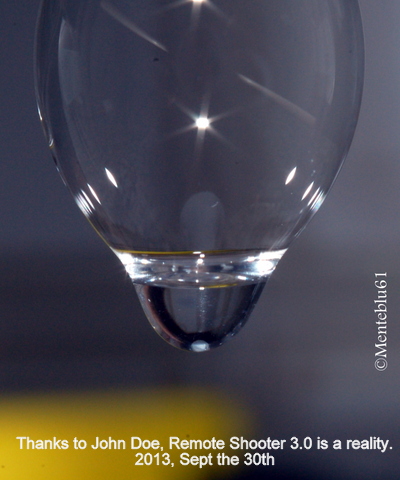
RemShootSupporter gift sample photo:
venerdì 23 dicembre 2011
Controlling a digital camera via USB port, now with a Microchip PIC24 family microprocessor

Now with a PIC processor (24 or 32 of the Microchip family) you can control a camera that automatically execute many commands with a system based on a Microchip microcontroller functions with USB Host / OTG embedded.
NEW:
tested on:Nikon Coolpix AW100
Nikon D50
Canon Powershot A300
Canon Poweshot S500
The basis of the project
Always been passionate about photography and electronics, i tried to combine my two hobbies in order to explore new filming techniques and high-speed, with the help of automated systems. The first problem 'was born as camera manufacturers often do not disseminate technical information on the functions of their internal models. Inspired by some of Arduino projects, (particularly that of Alex Glushchenko) and Linux (http://sourceforge.net/projects/libptp/, http://libptp.sourceforge.net/README) after months of work with a friend more skilled than I in C programming, we have designed and built a prototype that implements some USB host control functions of digital cameras via USB PTP protocol, using the embedded functions available on a PIC24F.Compatible between brands and models (PTP functions are not implemented in the same way), we tested some compact DSLR Nikon and Canon. The commands more 'interesting to implement for the photo enthusiast are:
1) Remoting of the shutter button (shutter)
2) Set / Read values of shutter speed, aperture, etc..
3) Interval (Time Lapse)
4) Remote control of motorized lens focus, depending on the cameras.
5) Bracket (for cameras that provide the function) to perform post-processing in HDR. For those not aware, the bracketing feature (usually found on DSLR) cameras in the shows "varied exposure bracketing", this includes the performance of at least 3 photos in sequence separated by a value of over-and underexposure (longer and shorter than expected) that allows you to "hit" the perfect photo or obtain a particular effect with special software, HDR (High Dynamic Range) by superimposing the three images (eg HDR).
The ability to remotely activate many functions (but especially the shot) on digital cameras make possible many photographs sometimes impossible or at least difficult to achieve with the traditional method because of human reaction times.I refer to as jerky in the world of high-speed photography '(fall of a drop of water or other liquid, explosion of balloons, etc.) or techniques of photography on a regular basis (even several hours) as the time-lapse (for example, to record the blossoming of a flower or the hatching of an egg) and 'easily achieved by combining this system with appropriate sensors, motion, light or sound
If you are interested in Remote Shooter assembled and tested, with LCD display, you can find it on Ebay Italy
Description of the prototype and function blocks.
We start with the description of the prototype starting its functional blocks. To work in the field the system must be powered by batteries and consume very little. The first checks the entire system consumes about 90mA with peak and 110mA when 'the backlight of the LCD display (timed and controlled directly from an output pin of the microcontroller).
Now let's see in detail the individual functional blocks:
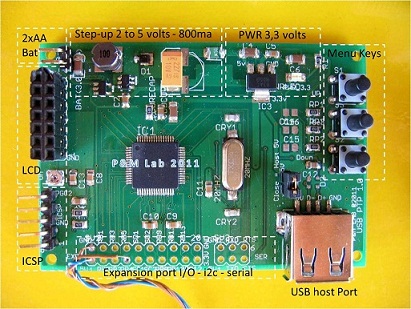
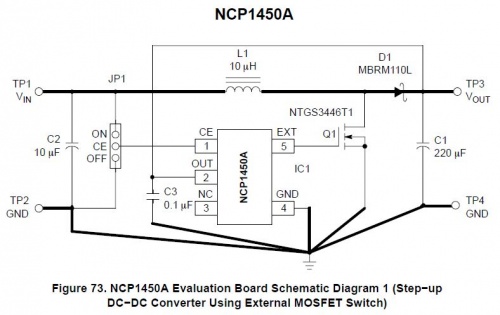
The first block consists of a PWM Step-Up DC-DC converter (NCP1450) with 2 AA batteries, which brings the voltage to 5 volts, with about 800mA max load. The chip 'was chosen because' it is quite efficient (88% max) and can 'work with input voltages from 1.5 to 4.2 volts. Though the CPU and also the LCD display (including backlight) work at 3.3 volts, the voltage to 5 volts is required for USB host functions and to power sensors or external circuits.
Carry the basic layout of the chip that we used in the prototype.
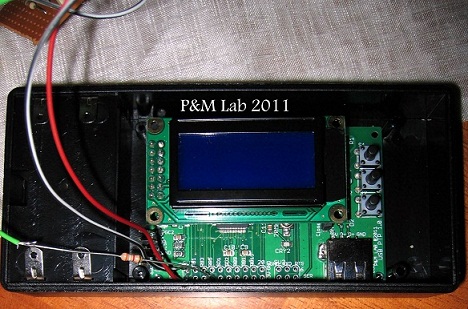
The second block is represented by a classic low dropout regulator (Reg1117) which reduces the voltage to 3.3 volts.Top right we have the three buttons that perform the function of navigation and choose from the menu that appears on the LCD 8x2 (double row connector on the left, with adjacent trimmer contrast).At the center of the PCB we PIC24FJ256GB106 the processor that has a quartz oscillator clock at 20MHz and 72MHz internal PLL configured. For programming and 'was prepared ICSP port (bottom left), as a programmer / debugger use the PICkit2 and 3 with the Microchip MPLAB sw.On the right we find the USB port in Host Configuration and down, centrally located, two rows of connectors for expansion I / O and any communication with sensors / devices or I2C serial (with appropriate external level translators).The prototype had a lot of potential '(the chip and' one of the most powerful and complete PIC24F family with 16Mips power, a lot of memory and 64-pin) can 'be used not only for the purpose for which and' born, but also as a tool development, and 'Simply use the expansion port to connect an analog voltage to be measured or PWM outputs to activate motors etc..Despite some concerns 'Initially, it was' chosen to achieve all or most of the PCB in SMD technology. The questions consisted of mounting a successful prototype SMD having no virtually no previous experience in this technique, and even more 'no technological means as this, and' a hobby for us. In fact the problem 'was brilliantly and in a few minutes, with the technology of the electric cooker at about 210 ° C and the miraculous solder paste that makes everything very simple, the constituent assembly formed in 0805 to 64-TQFP processor pin.Gli any short between pins of the chip during cooking were removed using desoldering braid flux and everything and then tested with the tester.Stages of assemblyThe prototype already 'welded during assembly, ready for the first functional tests (power supplies, buttons, displays etc.)
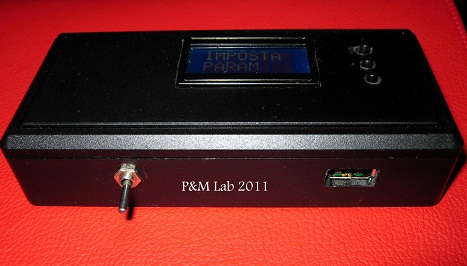
The prototype boxed and ready for the first field tests.
For communication with external sensors we used a DB9F connector which brings out the power supply to 5 volts and some pins of I / O.
The test image shooting camera when the sensor detects the interruption of the laser beam.
Setup based on a laser pen (left) and LDR (right) with attached Schmitt trigger circuit (with a 74HC14)
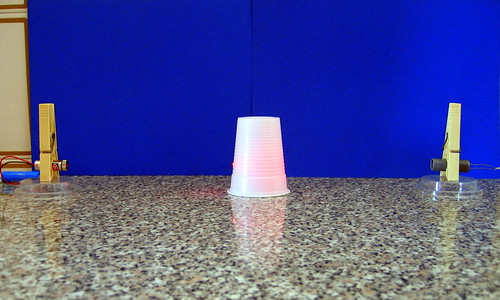
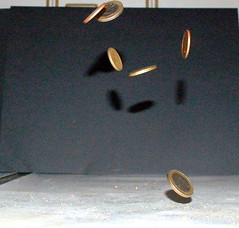
Here are some field test to give an idea of the potential with the integration of sensors which pick up sound or light:
 |
| Sound Trigger test |
 |
| Sound Trigger Test |
 |
| Laser Beam Detector |
 |
| Laser Beam Detector |
Link to some tests made with the prototype:
Test Time Lapse Video
Hi Tech Projects
For contacts mail me at gianluigi.perrella@gmail.com
Iscriviti a:
Post (Atom)